ECE 145: Modern Electric Power Systems
Harvard University, Spring 2027. Mondays and Wednesdays, 12:45 to 2:00 pm.
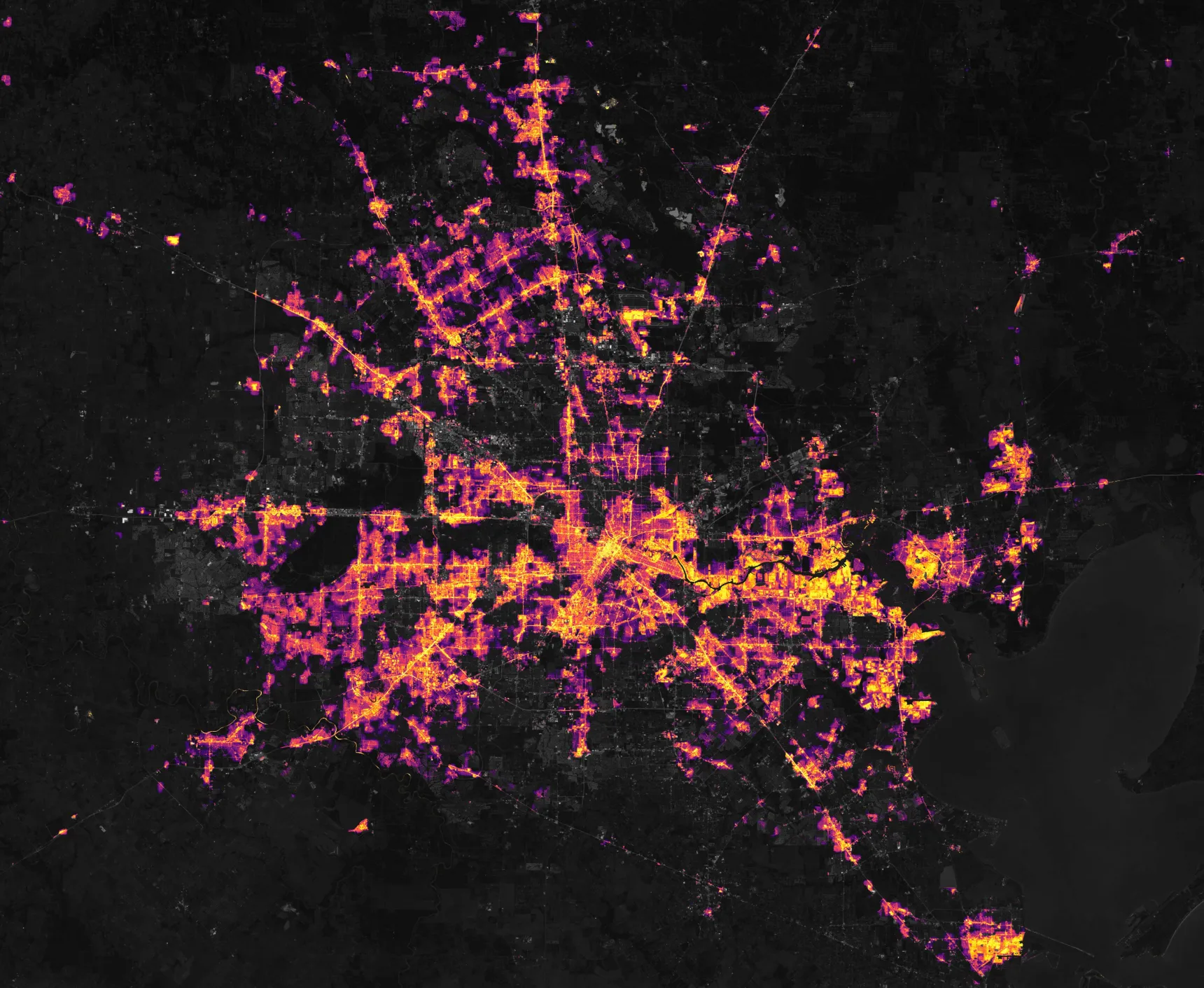
Houston, Texas, during the 2021 freeze in the ERCOT grid. Source: NASA Earth Observatory.
Course description
This course begins with a solid foundation in classical power system engineering, covering the basic operation and control of electric grids. It then explores the grid's transformation into a data-rich, power electronically interfaced system. It introduces modern AI-driven approaches for forecasting, renewable integration, and smart grid operations. Through hands-on learning with simulation software, realistic data sets, and case studies, students will bridge engineering fundamentals with data science applications. The course equips students with tools to understand, model, and design sustainable and intelligent power systems in the age of AI.
In this course, we will embark on a journey through the most intricate machine ever built by humans: the electric power grid. We will begin with generators, transformers, transmission lines, and the power flow equations, the fundamental laws that govern how electricity moves through a network. Despite more than a century of study, these non-linear equations still present captivating engineering challenges; to this day, just counting the total number of solutions is still an unsolved mystery. We will then follow the grid into the present day, as solar, wind, batteries, and electric vehicles connect to it through power electronics, and learn to harness scientific computing, optimization, and machine learning to model, operate, and design the grids that will power our world.
Learning objectives
Upon successful completion of this course, students should be able to:
Analyze single-phase and three-phase AC circuits, including unbalanced circuits and faults, and model generators, transformers, lines, and loads in per unit.
Construct matrix-based network models, such as the bus admittance matrix, which is a weighted graph Laplacian.
Solve the power flow equations numerically, and recognize when approximations such as DC power flow are appropriate.
Explain how grid frequency and voltage are controlled, and how inverter-based resources change the dynamics of the grid.
Analyze the power electronic converters that connect solar, wind, batteries, and data centers to the grid, and the harmonics they create.
Design computational tools for economic dispatch and optimal power flow, and interpret the locational marginal prices they produce.
Predict grid operating conditions with statistical and machine learning models, and reconstruct the power flow equations from measurement data.
Demonstrate how to manage and visualize large data sets of real grid measurements.
Assess the societal and ethical dimensions of how we design and operate the grid, such as fairness in pricing, energy burden, resilience, and the electricity demand of AI.
Course format
Lectures combine derivations on the board with interactive demos in Julia. Participation puzzles, worked in small groups, appear in some lectures. Two class sessions include simulation labs, one class is the written midterm exam, and one class is set aside for final project presentations. An optional visit to the Blackstone Steam Plant is planned for February.
I teach by working through small examples by hand and then running them at scale in code, so you see both the math and how it behaves on real grids. You can earn every point in the course without using AI. Each problem set asks you to predict what will happen before you compute it. Predictions are graded on your reasoning, not on whether they turn out to be right. The midterm can be revised, because I care more about what you know at the end than on one day in March.
The problem sets include Julia starter code from the course package, Steinmetz.jl; you may use any language. There is a final project and no final exam.
Typical enrollees
Undergraduates who want to understand how the electric grid works and how it is changing, usually in their second or third year. Electrical engineering concentrators can take it as an elective, and students from other engineering, physics, applied math, computer science, and environmental science concentrations are welcome.
Prerequisites: linear algebra (Math 21b or equivalent), and electricity and magnetism (Physical Sciences 12b, Physics 15b, or Applied Physics 50b). A circuits course (ECE 50/ES 50 or similar) is recommended. Probability, programming, optimization, and signals and systems help but are not required.
Readings
Main textbooks (available for free online):
Steven H. Low, Power System Analysis: Analytical Tools and Structural Properties, Caltech, 2026.
James L. Kirtley, 6.061 Introduction to Electric Power Systems, MIT OpenCourseWare, 2011.
Recommended textbook for power electronics:
Robert W. Erickson and Dragan Maksimović, Fundamentals of Power Electronics, 3rd ed., Springer, 2020.
Course documents
This course was formerly numbered Engineering Sciences 145 (ES 145).